Method
SegWithU treats the segmentation backbone as a fixed predictor and learns a small uncertainty head on tapped intermediate features. Uncertainty is parameterised as perturbation energy: rank-1 probes induce latent perturbations whose effect on output logits is the basis for the epistemic signal. Click any labeled box in the figure below to open the corresponding interactive 3D rendering.
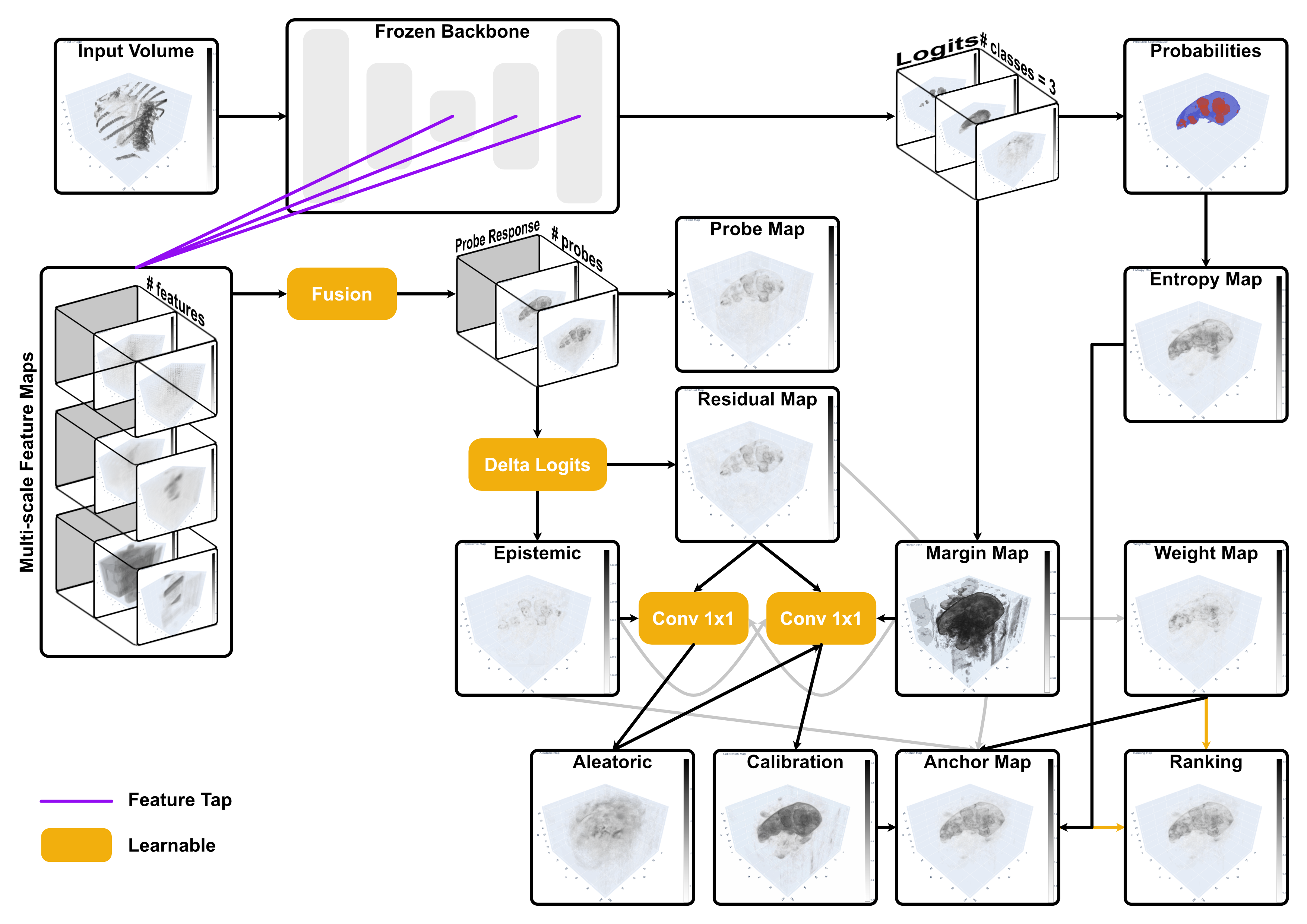
Overview of SegWithU. A frozen segmentation backbone produces logits and a probability map. Multi-scale intermediate features are tapped (purple) and fused into a probe response that yields a probe map. Rank-1 posterior probes induce class-logit perturbations (the residual map), whose variance gives the epistemic map. In parallel, an aleatoric branch reads the fused features. Auxiliary signals — entropy, margin, ambiguity weight — combine with these via lightweight 1×1 convolutions to produce two functionally distinct outputs: a calibration map that tempers logits via z̃ = z / √(1+Ucal), and an anchor → ranking map optimized for error ordering and selective prediction. Only the orange modules are learnable; the backbone is never modified.